-5,21%
Washed Away: The Decline of Europe’s White-Goods Industry
The manufacturing landscape for European household appliances is being reshaped by persistent cost headwinds and an increasingly sophisticated competitive challenge from China
For decades, the steady hum of a washing machine or the dependable chill of a refrigerator in a European kitchen was likely a product of domestic engineering. But that industrial rhythm is fading. Across the continent, the “white goods” sector—the heavy appliances that form the backbone of household life—is undergoing a quiet but systemic exodus. What was once a bastion of European manufacturing is increasingly being replaced by imports, primarily from a technologically and strategically ascendant China.
The numbers tell a story of steady erosion. Since the 2015-2019 period, European production of household appliances declined from approximately 31 million units per year to just 28 million. This is not merely a cyclical dip but a tangible dismantling of infrastructure. Over the same period, between 20 and 25 large-scale plants have been shuttered or liquidated—from the quieted assembly lines of Whirlpool in Naples to the collapse of Groupe Brandt in France, eliminating upwards of 10,000 direct manufacturing jobs. The machines that remain are increasingly concentrated in a handful of lower-cost hubs as the sector faces a “double squeeze” of energy and labor costs that has widened the competitiveness gap with Asia since 2020.
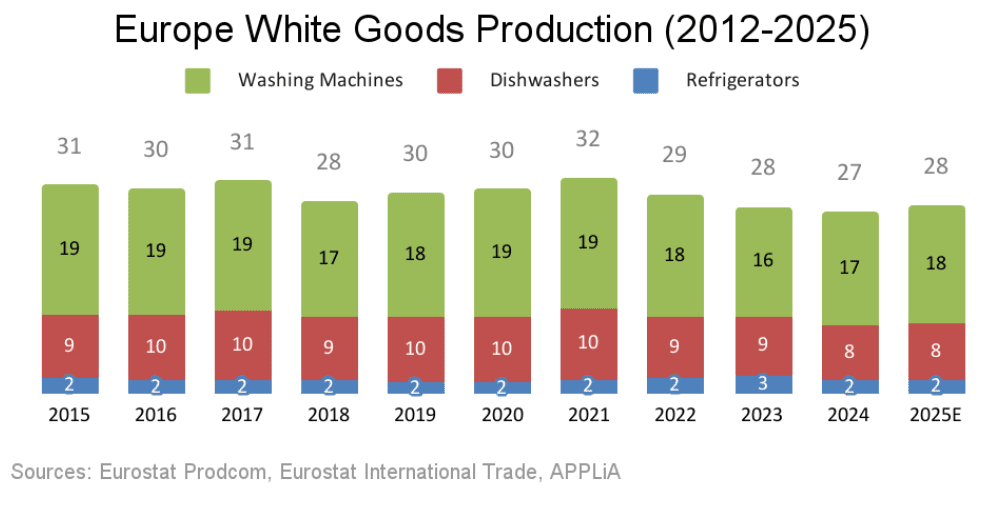
In the wake of the energy crisis, EU industrial electricity prices remained twice as high as those in the United States and roughly 50% higher than in China through early 2026. Compounding this, manufacturing labor costs in the EU have surged by over 20% since the start of the decade. For manufacturers of low-margin goods like dishwashers, these structural headwinds have turned Western European factories into unsustainable islands.
The industry’s response has been a frantic geographic reshuffling. Domestic giants are increasingly “offshoring” within the continent’s own borders to preserve what little margin remains. Miele, the German paragon of premium engineering, is currently in the process of relocating washing machine assembly from its historic base in Gütersloh to Poland. Meanwhile, Turkey has emerged as a critical pivot point, serving as a dual-purpose refuge. It is a home for regional champions like Arçelik—whose Beko brand now leads the European market by volume—and a fortress for European giants like Bosch, which has transformed its Turkish operations into one of its largest global manufacturing and R&D hubs.
Yet, as European firms retreat to safer ground, they are being met by an aggressive and highly sophisticated Chinese advance. China’s ascent is no longer a matter of mere mass production; it is a masterclass in industrial statecraft. By weaving a web of savvy acquisitions—swallowing venerable brands like Candy, Gorenje, and most recently the Teka Group—leading global groups have successfully integrated their manufacturing scale with the heritage and engineering expertise of established European brands. This strategic blend is supported by an expanding production footprint in regional hubs like Turkey, where facilities such as Haier’s recent plant expansions provide the capacity to serve the broader European market efficiently.
Perhaps most unsettling for European executives is that the competitive threat has moved beyond price. The old narrative of “cheap imports” has been replaced by a “smart” revolution. Recent international trade fairs have underscored a new era of efficiency, with the latest generation of products frequently setting benchmarks that move beyond the EU’s most stringent energy ratings. Driven by AI-integrated sensors and advanced heat-pump technology, these breakthroughs are redefining the premium segment of the market and establishing new expectations for performance and sustainability. This shift reflects a broader global movement toward high-value, technically sophisticated manufacturing that prioritizes extreme efficiency. Europe now absorbs 28% of China’s total appliance exports, with Chinese washing machine shipments to the EU growing at a blistering 14% CAGR since 2021, and 70% of Europe’s white goods imports originate from China.
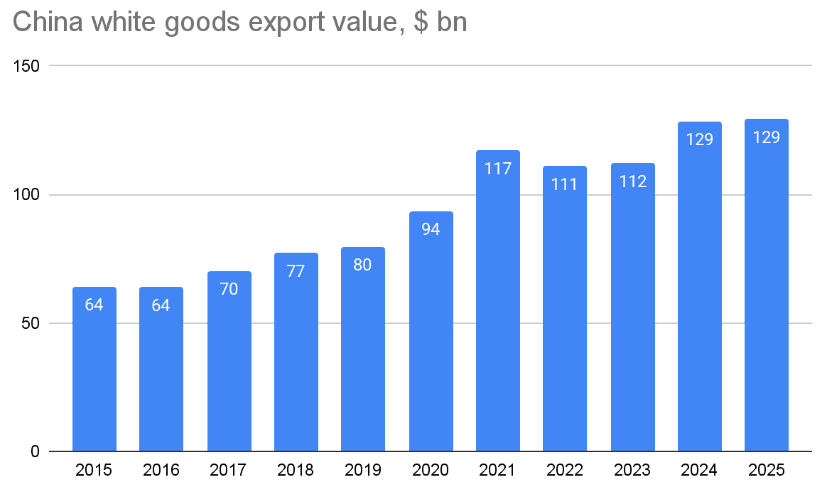
China appliance exports by region in 2025 and growth since 2021
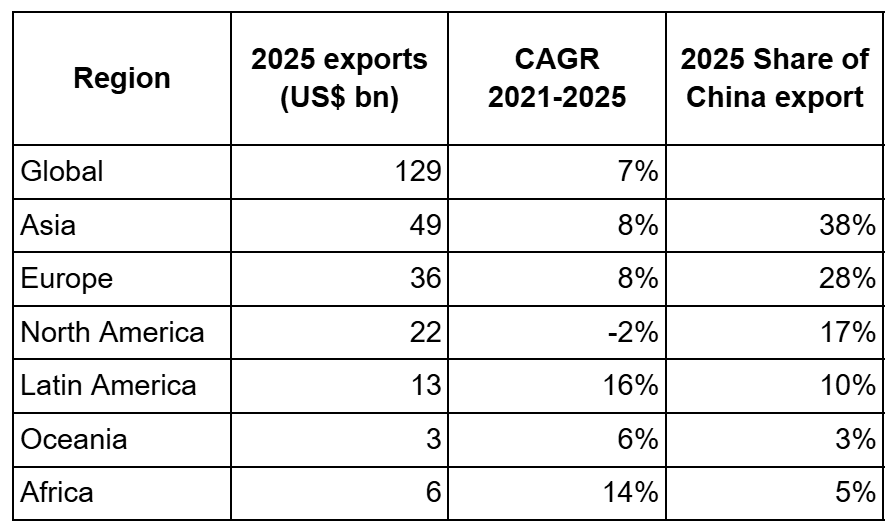
EU import from China, growth over 2021 to 2025
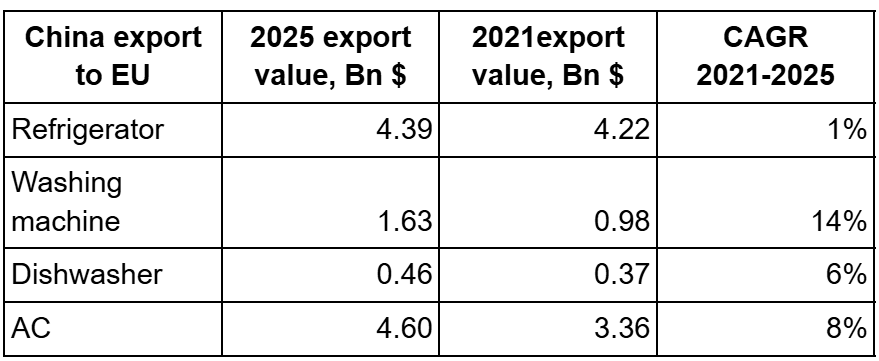
Data source: China Chamber of Commerce for Import and Export of Machinery and Electronic Products, Custom, Huatai Securities, CEIC
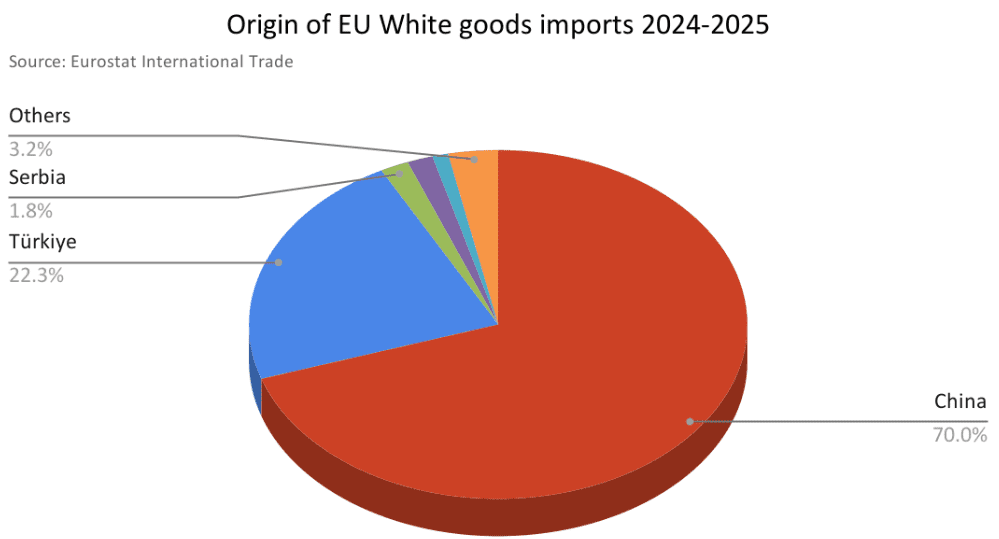
For the regional steel sector, these shifting production patterns represent a significant transition in traditional demand. As manufacturing footprints evolve, a greater portion of the high-grade material demand is being fulfilled via ’embedded’ steel in finished goods. With import penetration for washing machines and dishwashers now reaching 44% and 48% respectively, the value chain is becoming increasingly globalized. Projections for 2025 indicate that 1,400 kt of indirect stainless steel supply will move through these international trade flows, with the white-goods segment accounting for 285 kt—a key area of growth for indirect imports. Navigating this landscape will require a concerted focus on enhancing cost-competitiveness and accelerating smart innovation to ensure the long-term vitality of the regional industrial base.
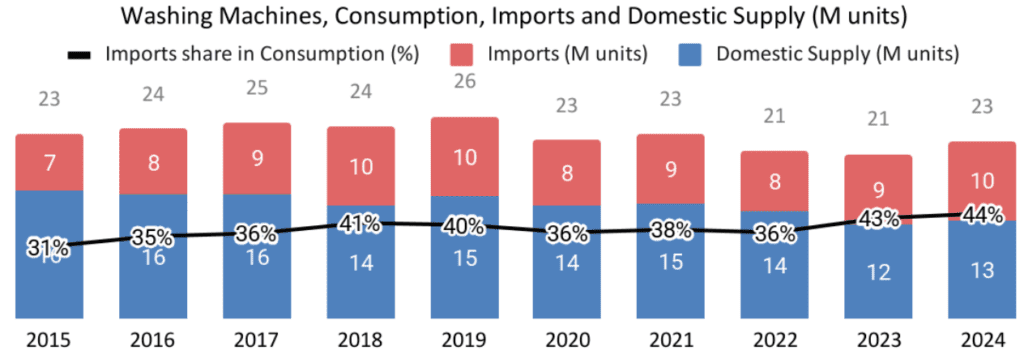
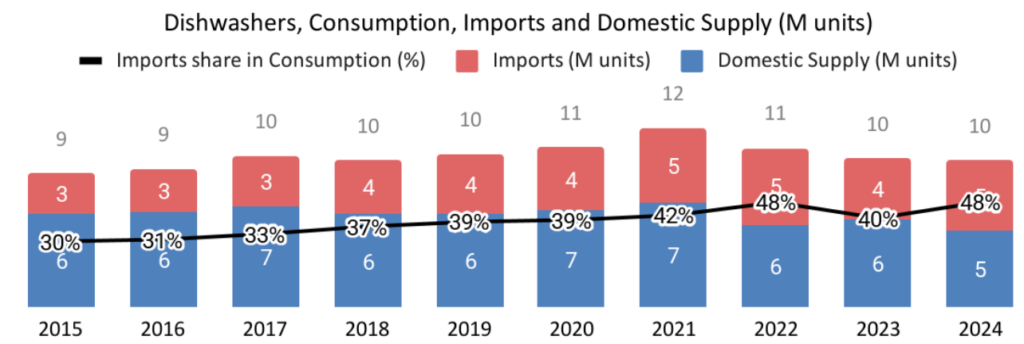
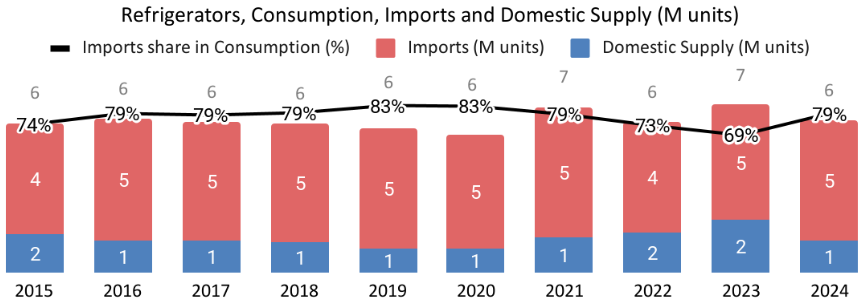
Note: Consumption calculated as production+imports-exports. Imports share is the share of imports over consumption.
Sources: Eurostat Prodcom, Eurostat Trade, APPLiA.
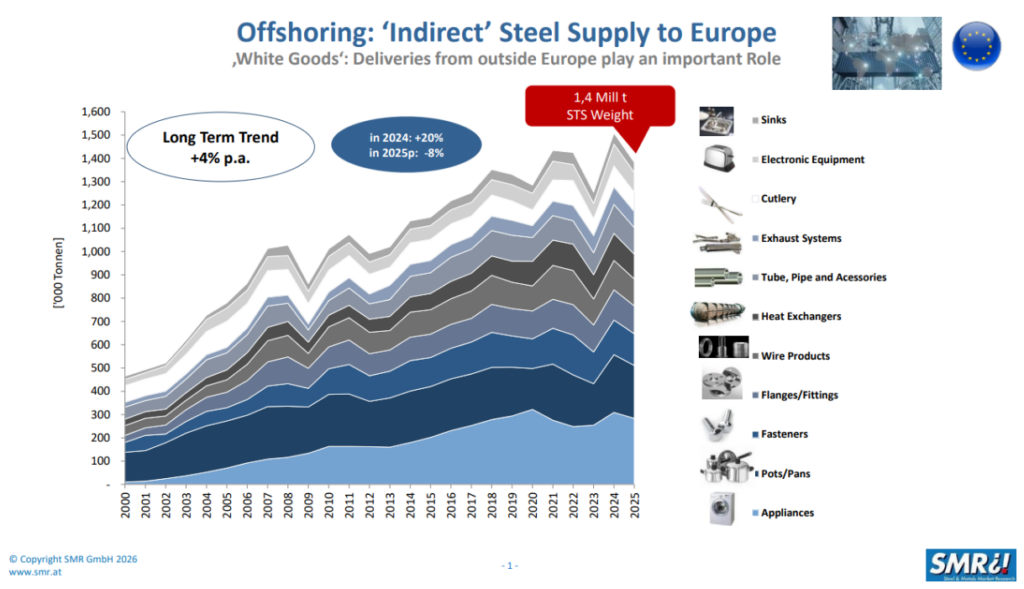
Sources and references:
- https://www.midea.com.cn/zh/about-midea/news/_teka_
- https://mp.weixin.qq.com/s/G9EkQTR93zdVbC0YxH4wag
- https://mp.weixin.qq.com/s/CajHKeiusev5II6bjg87lA
- Italian workers fight against closure of Whirlpool in Naples, IndustriALL.
- Beko Europe launches as Whirlpool–Arçelik merger completes, kbbreview.
- Brandt, France’s last major home appliance maker, is liquidated, Le Monde.
- The crisis surrounding Beko Europe and worker protection, European Parliament.
- Energy Cost Gap: IEA (2026) Electricity Analysis – Confirms EU industrial prices remain twice US levels and 50% above China.
- Labor Costs: Eurostat (2026) Labour Cost Index – Details the ongoing rise in EU manufacturing costs, showing 3.7% annual growth into 2026.
- Miele Relocation: K-Online News – Reporting on Miele’s strategy to shift assembly to Poland for “favourable cost situations.”
- Haier Expansion: Haier Europe Corporate – Official details on the million-unit capacity plants in Turkey.
- China Innovation: Xinhua / IFA Berlin 2025 – Documentation of Chinese appliances exceeding EU Class A efficiency standards by 30-70%.
- Beko Europe Market Position: PR Newswire / Arçelik – Confirmation of Beko Europe as the largest white-goods player in Europe by volume.