
 -0,53%
Competing with China: Playing a Different Game
Western firms cannot match China’s capital costs or strategic horizons. They must change the game – or accept the consequences.
For the past two decades, Western industrial firms have on the whole been better-managed and more productive than their Chinese counterparts. They have also been losing. In sector after sector—solar panels, shipbuilding, drones, lithium-ion batteries, electric vehicles, high-speed rail – global market share has shifted from Western producers to Chinese ones. The pattern is too consistent, and too broad, to be explained by Western failure alone.
The asymmetry has become impossible to ignore. But its mechanics deserve closer examination. This is not, fundamentally, a story about subsidies, currency manipulation or unfair practices, important though those are. It is a story about two different theories of how industrial economies should work—and the discomforting conclusion that one of them may be structurally incompatible with the other.
An uneven playing field
The OECD’s MAGIC database, released in its public form in June 2026, provides the clearest picture yet. Chinese firms receive on average three to eight times more government support than competitors in OECD countries (see chart 1). Crucially, the OECD concludes that some 59% of Chinese firms’ global market-share gains between 2005 and 2023 can be explained by the subsidies they received. The majority of Chinese industrial dominance reflects state support, not productivity advantages.
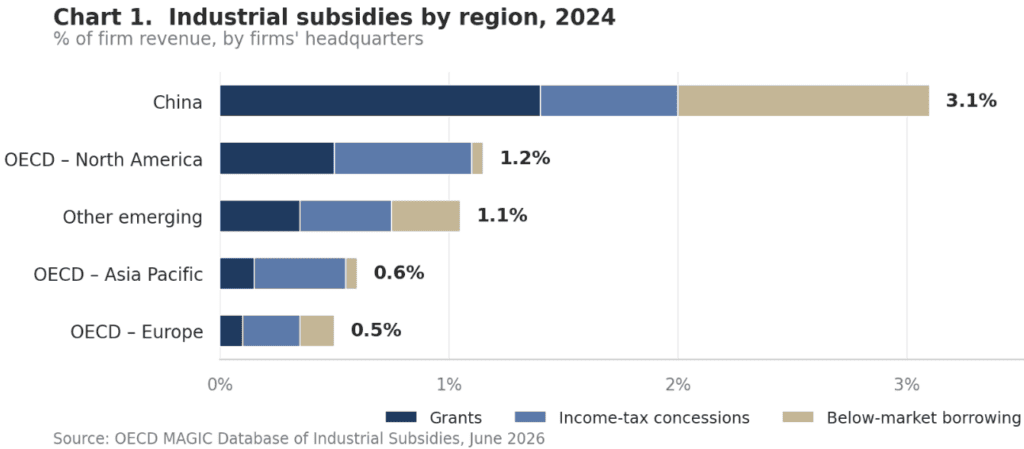
The mechanism runs deeper than headline subsidies. Most Chinese corporate loans are issued by state banks at rates close to the country’s one-year benchmark, regardless of credit risk. Chinese firms borrow at rates often 200 to 400 basis points below comparable OECD firms – a continuous, invisible subsidy that operates at scale. According to the OECD, 32% of Chinese industrial firms lose money yet remain operational, sustained by below-market finance while Western competitors with healthier accounts go bankrupt.
This financial endurance is not a banking anomaly; it is an intentional strategic disposition. Sun Tzu offers a useful frame. The Art of War counsels yǐ yì dài láo – wait at ease for the tired enemy. The classical 36 Stratagems include jiè dāo shā rén (borrow another’s sword to kill) and gé àn guān huǒ (watch the fires burning across the river). These maxims describe a strategic disposition that prizes patience, indirection and the exhaustion of opponents over frontal engagement. They map uncomfortably well onto Chinese industrial strategy: invest aggressively when others retrench, accept losses to build position, let competitors exhaust themselves in margin compression, then acquire their assets cheaply. China did not invent this approach; state ownership and policy-bank financing make it executable at industrial scale in a way no private Western company can match.
The roll call
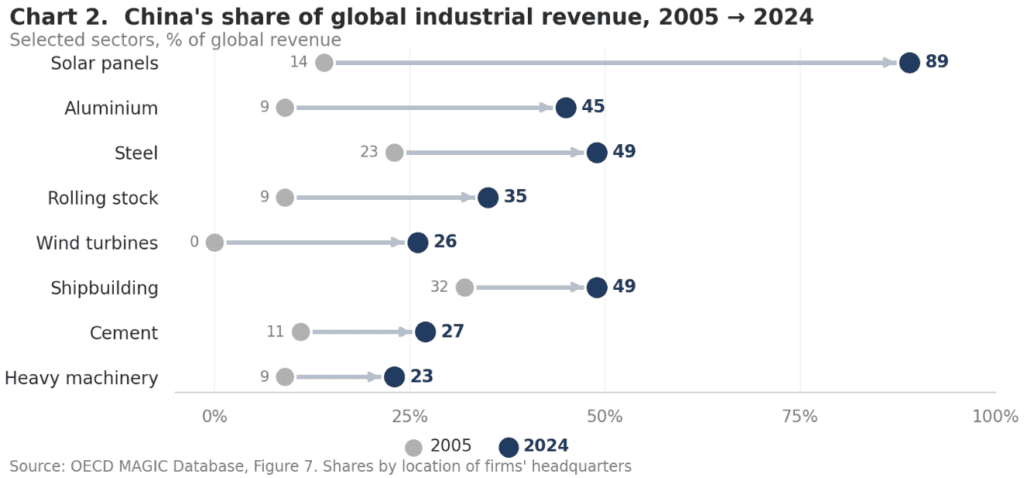
The list of industries Western firms have effectively lost is now long. Solar panels: in 2005 OECD-based producers held roughly four-fifths of global production. By 2024 their combined share was below 10%, with Chinese manufacturers accounting for over 90% of global module shipments. Shipbuilding: European yards’ share of global commercial deliveries fell from 15% in 2005 to 5% in 2024, while China’s rose from 19% to 51%, rapidly closing the ‘reliability premium’ gap even in high-spec, complex fields like LNG carriers. Lithium-ion batteries, drone manufacturing, high-speed rail, basic displays and large segments of commodity steel and chemicals have followed similar trajectories (see chart 2).
Yet some Western industries have not just survived but flourished against Chinese competition. ASML, a Dutch firm of 40,000 employees, maintains a global monopoly on extreme-ultraviolet lithography machines – the equipment necessary to produce the most advanced semiconductors. No Chinese firm has come close to replicating it, despite a decade of concentrated state effort. Roche, Novartis, Eli Lilly and Novo Nordisk anchor a pharmaceutical sector that remains globally dominant, defended by patent systems, regulatory complexity and the scientific depth of integrated drug discovery. Industrial gases – a quieter but equally instructive case – remain dominated by Linde, Air Liquide and Air Products, whose moat rests on pipeline networks, on-site air-separation plants embedded inside customers’ facilities and multi-decade supply contracts that no Chinese entrant has been able to displace. A narrow tier of German industrial specialists – Trumpf in industrial lasers, Beckhoff in automation, Zeiss (through the Carl Zeiss Foundation) in high-end optics – still hold positions built on deep application engineering and family or foundation ownership willing to forgo cyclical maximisation for cumulative position. The broader Mittelstand, however, is now under acute pressure: China’s ‘10,000 Little Giants’ state programme is explicitly designed to replace the hidden-champions model at scale, and Chinese firms already control roughly a third of global machinery production.
A pattern emerges. The industries Western firms lost share commodity characteristics: standardised products, scalable manufacturing, modular technology, price-competitive customers. The industries they have kept share other properties: deep intellectual property accumulating over decades, regulatory or certification moats, embedded customer infrastructure, application engineering for demanding customers, and ownership patient enough to forgo short-term returns. The survivors are not where Chinese state capital cannot reach; they are where it has limited purchase. ASML’s lithography knowledge cannot be replicated by spending more on it. A pharmaceutical patent cannot be invalidated by political will. An air-separation plant inside a customer’s steel mill cannot be undercut by an excellent factory in Guangdong.
Time horizons and ownership
Beyond subsidies lies a structural gap Western firms cannot easily close on their own. A typical Western public company requires a 12-15% IRR to approve a major industrial investment, with payback periods of three to seven years. Chinese state-backed competitors operate at a 4% capital cost, with 15-20 year planning horizons and explicit tolerance for losses in pursuit of strategic position. These are not preferences but functions of ownership. Quarterly reporting, dispersed shareholding and activist investor pressure impose short horizons on Western firms; concentrated state ownership, policy-bank financing and political performance metrics impose long ones on Chinese ones. Calls for Western firms to “think long-term” repeatedly fail because the firms making them remain accountable to shareholders who think quarterly.
Playing the same game by different rules
The hardest response – and the most important – goes against Western corporate instinct: explicitly adopting Chinese-style time horizons while keeping a Western-style operating model. In practice this means 15-20 year strategic plans rather than 3-5 year payback hurdles; acceptance of 8-10% IRR rather than 12-15%; patient family or sovereign-wealth ownership rather than quarterly-reporting public equity; a commitment to remaining in an industry as a core value rather than maximising current returns; and decisions made by people who will be there long enough to see them play out.
This is harder than it sounds. Public-equity-funded firms cannot simply choose patience; their capital providers impose impatience structurally. The Western players that have matched Chinese-style time horizons share unusual ownership: family-controlled industrial firms such as Trumpf and Würth; foundation-controlled industrials including Germany’s Carl Zeiss Foundation (owner of Zeiss and Schott) and Denmark’s Novo Nordisk Foundation, whose patient capital underwrote the 25-year GLP-1 research arc; investor vehicles like Sweden’s Wallenberg foundations, which through Investor AB control ABB, Ericsson, AstraZeneca, SKF and Atlas Copco; and sovereign-wealth-backed industrials such as Singapore’s Temasek. Where these structures exist, they have proved remarkably effective. Reproducing them at scale—through expanded public-private vehicles in the mould of France’s Bpifrance, Germany’s KfW or Temasek itself, and consortium structures that pool immense R&D risk—is the central task of any serious Western industrial strategy. This is not state capitalism in mirror image; it is the recognition that some industrial outcomes require capital structures that public equity markets cannot, by design, provide.
Government plays a supporting role. Industrial policy – America’s CHIPS Act, the EU’s Green Deal Industrial Plan, Brazil’s Nova Indústria Brasil—has narrowed but not closed the subsidy gap, which still runs two to four times Western levels. Trade defence – tariffs, expanded Section 232 actions, proposed Section 301-equivalents in Europe – can slow erosion. Behind both lies an uncomfortable question: can free trade coexist with state capitalism? The honest answer is probably no. The post-1994 WTO framework assumed comparable economic systems, in which subsidies were exceptions to be policed rather than the rule to be lived with. China’s model violates that assumption by design. The choice is not whether to maintain free trade with China but how to manage – through tariffs, restrictions or sectoral protection – a permanent state of partial trade with a fundamentally different system.
Winning on different terms
The right objective is not to win on Chinese terms but to redefine the terms on which Western firms can win. They cannot become Chinese firms; their ownership structures, capital markets and political systems will not permit it. Nor should they want to. But they can choose where to compete – on dimensions where Chinese state capital has limited purchase. Patience: Novo Nordisk’s GLP-1 research, begun in the 1980s, produced its blockbuster therapies four decades later. Depth: ASML’s extreme-ultraviolet lithography is the product of thirty years of accumulated process knowledge that capital alone cannot buy. Customer intimacy: the Mittelstand model of decade-long, application-specific engineering partnerships with industrial buyers who value reliability over price. The shift in unit of strategic time, from the quarter to the decade, is the precondition for everything else.
The companies that have thrived through this competition – ASML, Schneider Electric, Lego, Roche, Air Liquide, Trumpf and Zeiss among them—did not beat China at China’s game. They are not consolation-prize survivors either: ASML is Europe’s most valuable listed company, and Schneider Electric grew to €38bn in annual revenue. Novo Nordisk’s recent setbacks do not undermine the argument: foundation ownership underwrote the multi-decade bet that built the company, and the same patient capital will be needed to underwrite whatever comes next. The strategic insight is that within a single industry, different firms can play very different games—and Western firms can choose to play the one Chinese state capital cannot follow.
Winning Chinese state capitalism does not require defeating it. It requires defining victory on different terms – and playing a long enough game to make those terms stick. As China systematically scales into high-spec engineering niches, these deep technological moats must be fiercely defended – including through means that would have seemed illiberal a generation ago. The rest of Western industry must make that shift, or accept the consequences of not having done so.
SOURCES
- OECD, OECD MAGIC Database of Industrial Subsidies (June 2026).
- OECD, The Market Implications of Industrial Subsidies, Trade Policy Paper No. 296 (2025).
- Mario Draghi, The Future of European Competitiveness (European Commission, September 2024).
- Enrico Letta, Much More Than a Market (April 2024).
- S. Tordoir and B. Setser, Centre for European Reform (2026).
- The Wall Street Journal, China Is Devastating the Last Stronghold of German Industry (July 3rd, 2026)