-1,03%
A New Era for EU–Mercosur Trade Relations
After two decades of negotiation, the EU–Mercosur trade agreement is set to boost exchanges between both regions. The deal promises wider market access and closer industrial partnerships, particularly in metals and manufacturing. In this article, Cristina Marques highlights the key figures, benefits and challenges behind one of the most ambitious trade initiatives of recent years.
The impulse to organize and regulate economic activity is far from new. As early as the 10th century, merchant guilds were established to protect and manage trade within specific professions, especially as merchants began traveling from one town to another.
In the 20th century, just a year after World War I, countries increasingly negotiated various economic and broader agreements to govern international trade — starting with the creation of the League of Nations in 1919, followed by the General Agreement on Tariffs and Trade (GATT) in 1947, and later the World Trade Organization (WTO), which has fulfilled this role since 1995.
At the regional level, several trade agreements stand out for their success. The European Economic Community (EEC), founded in 1957, laid the foundation for today’s European Union and set a precedent for deep regional economic integration. Similarly, the Association of Southeast Asian Nations (ASEAN), established in 1967, adopted cooperative frameworks inspired in part by the EEC. In North America, the North American Free Trade Agreement (NAFTA)—later updated to the United States–Mexico–Canada Agreement (USMCA) during the Trump administration—has been a key driver of regional goods and services exchanges since 1994.
This momentum has only accelerated. According to the World Bank, the number of trade agreements worldwide grew from just 50 in 1990 to over 280 by 2017. Major economic blocs are now intensifying their integration efforts, either by deepening regional ties or forming broader coalitions based on shared interests.
A prominent example of a bloc with growing influence is BRICS+, a grouping based on strategic and economic commonalities rather than geographic proximity. In 2024, the core BRICS nations (Brazil, Russia, India, China and South Africa) recorded a GDP growth rate of about 4.0%, outpacing the global average of 3.3%. With its expanded membership and partner countries, BRICS+ is expected to represent 39–44% of global GDP in 2025, signaling its rising role in shaping the global economic order.
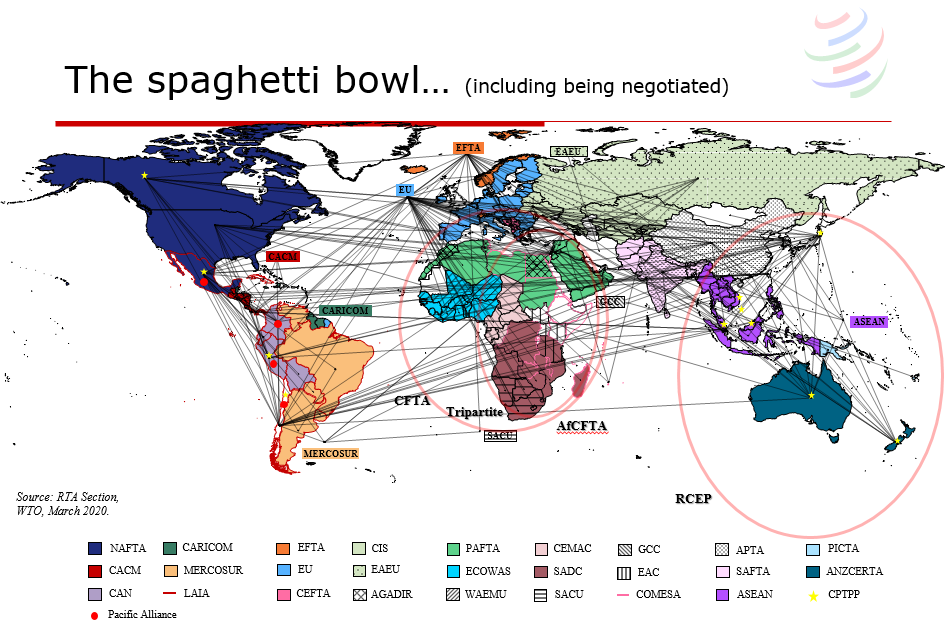
Another example, based on regional common interests, is the Regional Comprehensive Economic Partnership (RCEP), which officially launched in 2022 and rapidly became a pivotal force in Asia. According to World Economics, by 2025, the 14 RCEP member countries will represent 32.6% of global GDP. In 2023 alone, trade among RCEP members reached approximately USD 5.6 trillion, accounting for around 15% of total global trade. Furthermore, the region attracted USD 234.1 billion in greenfield investments in 2023—a 29.8% year-on-year increase, more than doubling the 2021 figure.
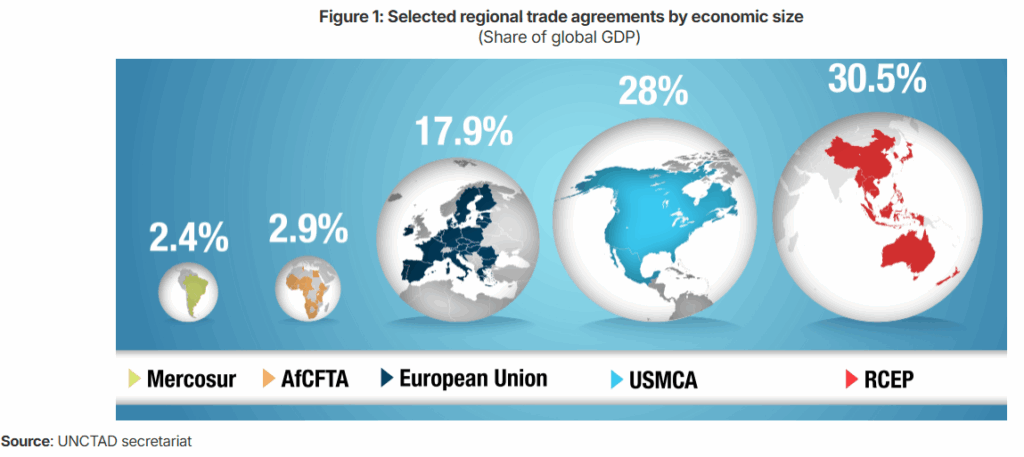
Other regional agreements are more modest in scope, such as Mercosur (Southern Common Market), but are willingly expanding. Its full members include Argentina, Brazil, Paraguay, Uruguay and Bolivia, which officially joined in 2024. Venezuela was also a member but has been suspended since 2016 due to non-compliance with democratic and trade commitments.
Associated partners include Chile, Peru, Colombia, Ecuador, Guyana and Suriname, which maintain trade and cooperation agreements without full membership. In addition, Mexico, New Zealand and South Korea participate as observer states, contributing to political and economic dialogues.
Despite its challenges, Mercosur ranks among the largest economies in the world, with a combined annual GDP of USD 3.0–3.5 trillion, driven largely by Brazil and Argentina. The intra-trade rate is quite low compared with that of the EU, but Mercosur remains a key player in South American economic integration.
Focus on the EU–Mercosur Trade Overview (2024–2025)
The European Union (EU) and Mercosur maintain a robust and expanding trade relationship, with total trade reaching €111.2 billion in 2024—comprising €56.0 billion in EU imports and €55.2 billion in EU exports. Over the past decade (2014–2024), EU imports from Mercosur have grown by more than 50%, while EU exports to Mercosur have increased by approximately 25%, underscoring a deepening economic partnership.
The trade structure between the two blocs reveals a complementary pattern. More than 80% of EU imports from Mercosur consist of primary goods, including agricultural products, minerals and pulp & paper. In contrast, nearly 87% of EU exports to Mercosur are manufactured goods such as machinery, chemicals and transport equipment.
Furthermore, the EU remains a vital investor in Mercosur countries, with significant foreign direct investment supporting economic ties.
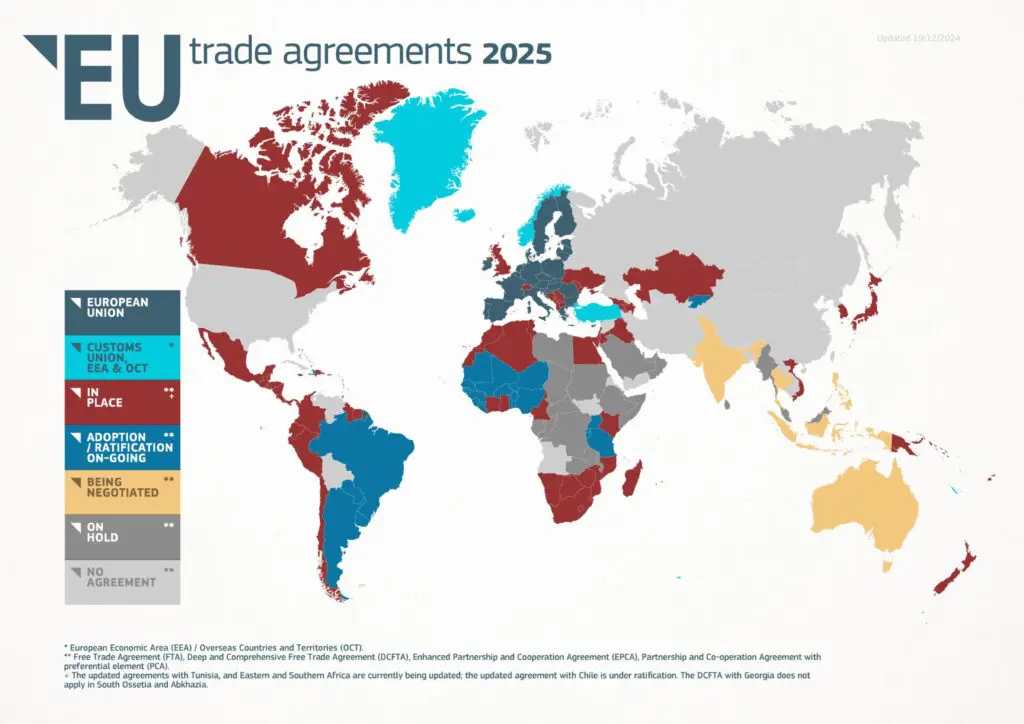
To enhance this already dynamic trade relationship, the European Union and Mercosur finalized in December 2024 a landmark Free Trade Agreement (FTA), concluding years of complex negotiations and paving the way for closer economic cooperation—bringing both challenges and opportunities.
Opportunities
The agreement offers major opportunities by expanding market access to over one billion people across both regions. It will eliminate or reduce tariffs on more than 90% of traded goods, encouraging greater investment and economic integration. Notably, more than 30,000 small and medium-sized EU enterprises currently export to Mercosur. Under the agreement, these SMEs are expected to benefit from streamlined trade procedures and lower costs due to reduced tariffs.
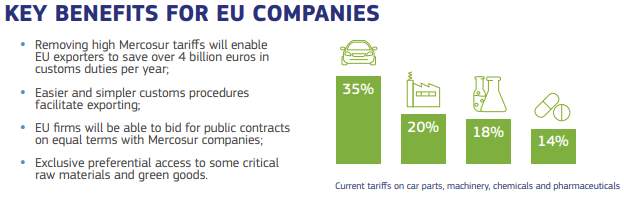
Recent estimates from Brazil suggest that the EU-Mercosur trade agreement could increase trade between the two blocs by 5.1%. Brazil projects an additional USD 18.84 billion in trade by 2044—of which USD 8.42 billion in imports from the EU and USD 10.42 billion in exports to the EU—reflecting a gradual but significant boost in bilateral commerce.
According to S&P Global, the agreement is also expected to enhance exports in specific sectors. For instance, EU dairy exports could increase by 91–121%, while beverages, particularly wine and spirits, may rise by 36–38%.
Furthermore, the agreement will help secure a sustainable supply of critical raw materials essential to the EU’s green and digital transitions while lowering tariffs on those and derived products, incentivising Mercosur exports to the EU. It will provide more security and predictability on this peculiar supply chain as well as ensuring one of the highest sustainability standards in critical raw materials trade and investment.
The deal is also expected to increase foreign investment in Mercosur by creating a stable regulatory environment and strengthening economic ties between the regions. It also includes key sustainability commitments related to climate change and labor rights.
Finally, the agreement will help diversify and stabilize supply chains while expanding customer and supplier networks for a better visibility.
Challenges
The EU-Mercosur agreement faces major challenges, including environmental concerns over Amazon deforestation, potential conflicts with the EU’s Deforestation Regulation, and uneven benefits that worry some industries on both sides—particularly the agricultural sector, a core concern for EU farming countries. However, as of September 2025, the European Commission officially launched the ratification process. While some member states remain hesitant due to their own domestic obligations, the agreement is currently expected to enter into force by late 2026 or early 2027.
To summarise
Drawing from past trade agreements that have successfully driven development, the EU-Mercosur Trade Agreement offers strong potential for economic growth, investment and strategic cooperation.
However, its long-term success will depend on how effectively both regions address environmental, regulatory and political challenges. A balanced approach between trade liberalization and sustainability will be essential to ensure credibility and lasting impact, further strengthening an already vivid relationship.
We at Aperam closely monitor these evolving landscapes and are committed to sharing our insights and expertise to help identify the most suitable solutions.
Focus on EU and Brazilian Stainless Steel
Mercosur countries—particularly Brazil—boast a robust stainless steel industry serving both domestic and international markets. Aperam leads the region, operating multiple facilities producing a wide range of stainless steel grades. Its exports—both flat and long products—reach markets in the Americas, Europe and Asia and are widely used in manufacturing, construction and automotive sectors.
Currently, Brazilian flat stainless steel benefit from duty-free access to the EU and are not subject to quotas under the existing EU safeguard mechanism, which is scheduled to expire on 30 June 2026. In contrast, European flat stainless steels face a 12.6% tariff upon entry into Brazil and at a even wider range when it comes to some other Mercosur countries.
Under the Mercosur agreement, most Brazilian tariffs will be gradually eliminated, although certain products deemed “sensitive” will benefit from longer phase-out periods.
On the EU side, the proposed revision of the safeguard mechanism by the European Commission foresees the inclusion of Brazil in the EU quota system, meaning that volumes exceeding the quota will be subject to a 50% duty.
Sources:
- Some history around the guilds
- https://www.worldbank.org/en/topic/regional-integration/brief/regional-trade-agreements
- https://www.worldeconomics.com/Regions/RCEP/?
- https://unctad.org/news/asia-pacific-partnership-creates-new-centre-gravity-global-trade
- https://english.www.gov.cn/english.www.gov.cn/news/202501/10/content_WS67805bbbc6d0868f4e8eea63.html?
- https://ec.europa.eu/eurostat/web/products-eurostat-news/w/ddn-20250620-3?
- https://ec.europa.eu/commission/presscorner/api/files/attachment/881527/Factsheet%20EU-Mercosur%20on%20Key%20facts%20about%20the%20agreement.pdf
- https://agenciabrasil.ebc.com.br/en/economia/noticia/2024-12/eu-mercosur-agreement-expected-boost-brazils-trade-brl-94b?
- https://www.spglobal.com/marketintelligence/en/mi/research-analysis/eumercosur-trade-deal-has-limited-impact-on-european-a.html?
- https://www.fastmarkets.com/insights/brazil-increases-import-duty-to-25-quotas-include-hrc-crc-hdg-galvalume-tubes/
- https://policy.trade.ec.europa.eu/news/commission-launches-consultation-future-measures-safeguard-eu-steel-sector-unfair-trade-practices-2025-07-18_en