
 -1,32%
316A: A breakthrough in material innovation
Cut your stainless steel costs without changing your processes or compromising on final product quality. Sounds impossible? Aperam Innovation Lab has done it. Introducing 316A: an all-new, exclusive, certified grade by Aperam.
European manufacturers are under increasing pressure to find new ways to curtail costs while maintaining the performance and durability of their products.
“Innovative new materials can help mitigate the volatility of raw material prices, the hidden costs of manufacturing inefficiencies, and the margin-eroding effects of overspecification,” says Gwénaëlle Le Meur, Market Innovation Director. “They can also help satisfy customer demand for durability, ease of use, and faster timeto-market.”
A case in point: Aperam’s new 316A grade of stainless steel. According to Bertrand Petit, 316A Research Project Leader, 316A was designed to give manufacturers the corrosion resistance of 316L at a significantly lower price. “We saw that even when 316L’s superior corrosion resistance is required for the application, customers often hesitate due to its higher cost compared with 304 and the volatility of nickel-based pricing” he says. “316A was born out of the idea of giving our customers the option to upgrade to the benefits of 316L without paying the costs.”
A (stainless) star is born
316A isn’t the result of some magic formula. The breakthrough lies in the work of Aperam’s Innovation Lab, which discovered a remarkable effect that occurs when one strikes the right balance between the alloy’s silicon content and its other chemical elements such as molybdenum. The effect is a probable synergy that ultimately allows for a lowercost chemical composition without compromising performance.
“Like the performance leap of ferritic grades or the discovery of super duplexes, 316A represents a step change in stainless steel and material innovation,” notes Reiner Steins, Chief Innovation and R&D Officer.
Tested and validated
The comparability of 316A to 316L has been confirmed by standard electrochemical tests, as well as by industry-standard salt spray tests. The test results of the two grades are close not only for pitting and crevice corrosion at room temperature, but also for their mechanical properties. This includes performance at high temperatures (e.g., 500°C) and low temperatures (e.g., -75°C). Independent research institutions, such as BAM (Germany’s Federal Institute for Materials Research and Testing) and CNRS (the French National Centre for Scientific Research), have reached the same conclusions. CNRS conducted advanced surface analyses and a direct comparison of the passive films formed on both 316A and 316L. Although higher molybdenum content typically enhances corrosion resistance, researchers observed a Mo–Si synergy in 316A that results in a thicker passive layer enriched in chromium.
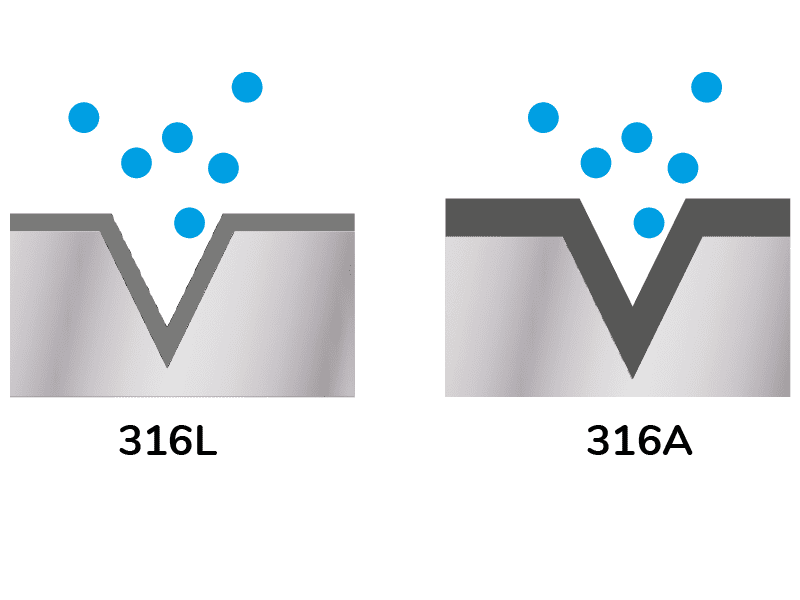
Further validation came from Aperam’s first industrial partners. Rieber, a manufacturer of high-quality mobile kitchen equipment, confirmed the strong performance of 316A in real operating conditions. In parallel, Grundfos, a leading manufacturer of energyefficient and intelligent water solutions, conducted extensive corrosion resistance tests, exposing both base materials and welds to aggressive solutions derived from a modified ASTM A923 procedure. The objective was to identify any potential susceptibility to pitting or crevice corrosion. The results demonstrated that the alloying composition of 316A ensures a stable protective mechanism under these demanding conditions, confirming its reliability as a robust, “plug-and-play” alternative to conventional grades.
With just 0.45% molybdenum, 316A has less than a quarter of the molybdenum content of its established counterpart, 316L. Instead, 316A uses more silicon (0.8 – 1%), a cost-effective alloying element that allows the material to match – or even exceed – the performance of 316L. “Stainless steel’s corrosion resistance generally depends on its passive layer, an ultra-thin, protective chromium oxide film that forms naturally on the material’s surface when it’s exposed to oxygen,” explains Audrey Allion, Surface Specialist Researcher.
The optimisation of the alloying elements (Si and Mo) contributing to the performance of the passive layer raises the corrosion resistance of 316A to the level of standard 316L. “A certain level of silicon content induces a level of corrosion resistance that exceeds what one would expect from a material with these alloying elements,” Allion says.
The new grade’s unique blend of molybdenum and silicon is also what allows it to achieve such an attractive price point. “By reducing manufacturers’ dependence on high-cost alloying elements like molybdenum, 316A lowers the alloy surcharge by up to 25% compared to 316L,” explains Mattias Candetoft, Global Business Development Manager. “Furthermore, it reduces exposure to surcharge volatility by up to 30%, thus enabling more predictable budgeting in unstable markets.”
Plug, play and save
Because 316A is designed as a technical ‘plug-and-play’ solution, manufacturers can leverage its performance and costsaving benefits without the need for investments or process adjustments. In fact, following successful test runs, several industrial fabricators have already seamlessly made the switch from 316L to the new 316A without altering any of their processing parameters. Even for complex forming operations, no process adjustments are required when switching from 1.4404 (316L) to the new 1.4682 (316A). Comparative measurements of the forming limit curves confirm the equivalent formability of both grades.
There are no modifications in joining techniques either. Parameters for laser and TIG welding notably remain unchanged, with 316A offering particularly favourable wetting properties during copper brazing – an interesting advantage in applications such as heat exchangers. 316A’s dimensional range is consistent with Aperam’s other austenitic grades, available in thicknesses from 0.06 mm to 13 mm and widths up to 2,000 mm. The grade is offered in all standard and polished surface finishes.
“For manufacturers, this means no downtime, no requalification, and no additional CAPEX, ensuring that 316A’s cost savings are not erased by hidden costs,” says Candetoft. “A seamless transition helps keep resources focused on production, not adaptation.”
A material ready for diverse applications
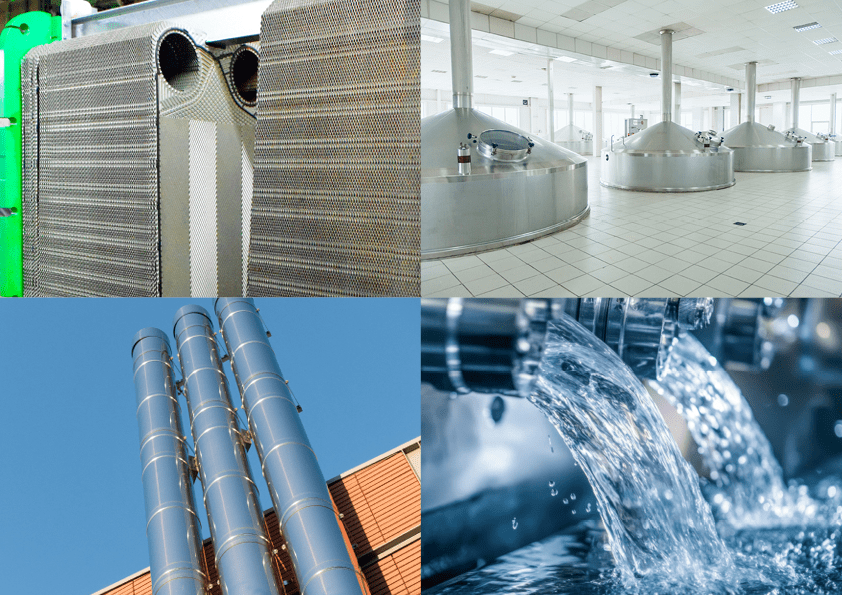
316A has been specifically engineered to address the needs of multiple industries where corrosion resistance, mechanical strength, and long-term durability are essential. The grade demonstrates strong potential for HVAC systems (heat exchangers, pumps), where exposure to humidity and thermal fluctuations calls for stable performance. Moreover, the use of more advanced stainless grades such as 316A helps reduce maintenance needs and extend equipment lifespan, thereby lowering total operating costs over time. In the building and construction sectors (roofing, façades, flue pipes), 316A combines mechanical robustness with aesthetic qualities suitable for both structural and architectural applications, particularly in outdoor environments. The grade also meets the hygiene and cleanability requirements of food and cosmetics processing, e.g. in line with EHEDG surface roughness guidelines for food contact equipment. Surface finish options are identical to those in Aperam’s standard offer, ensuring full compatibility with existing processing equipment and manufacturing practices.
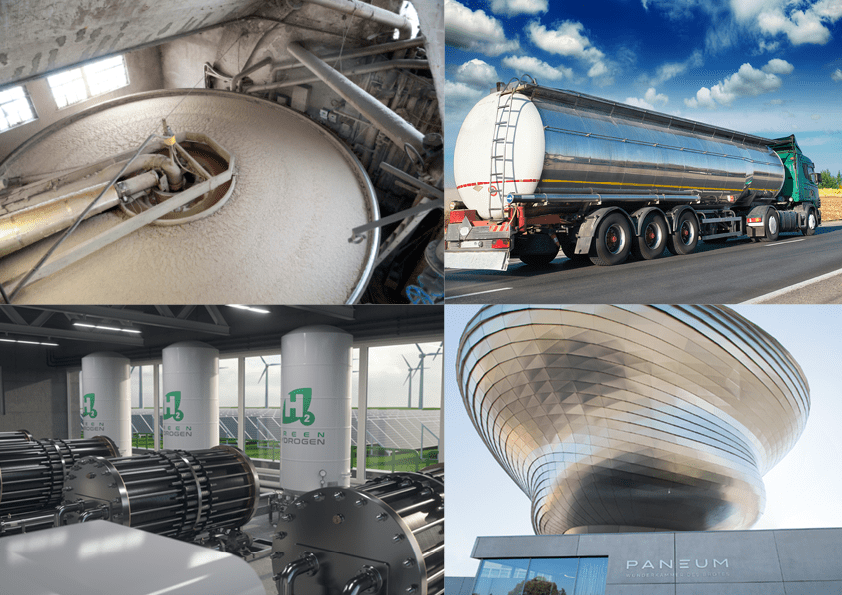
Beyond these markets, 316A is also suitable for industrial equipment, transport tanks and trailers, water treatment systems, electrolysers, carbon capture installations, mobility components, pipes and tubes. Raising the bar in material innovation, 316A is just the beginning of what Aperam believes will evolve into a material revolution. In collaboration with leading universities and research centres, the Aperam Innovation Lab is currently working to unlock the full potential of this groundbreaking grade – paving the way for the next generation of high-performance alloys.
Article published in Stainless Steel World Magazine – November