-1,25%
Stainless Steel: A Versatile Family Of Engineering Materials For Battery Electric Vehicles
The design priorities for EV battery housings include crash resistance, fire safety and, increasingly, recyclability, as mandated by upcoming EU regulations. Stainless steel presents significant untapped potential in this field. Aperam has developed prototypes to demonstrate these capabilities.
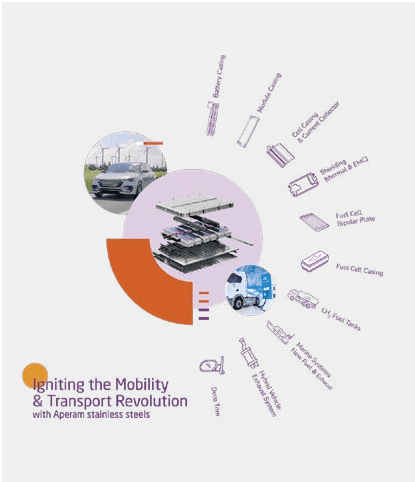
Applications include cell casings, module casings, upper covers and safety-critical structural components. The mechanical and physical properties of stainless steels make them highly suitable for such uses. Stainless steels comprise several families, each with specific microstructures and corresponding properties. Three are particularly relevant for automotive applications:
- Austenitic grades: Mainly nickel-alloyed, highly corrosion-resistant, and offering excellent forming and welding characteristics.
- Ferritic grades: Typically nickel-free, more costeffective, and valued for heat resistance and good deep-drawing properties.
- Duplex grades: Combining austenitic and ferritic structures, offering high corrosion resistance and mechanical strength at a moderate cost.
Fire containment and thermal insulation
The fire-containment capability of stainless steel is well established in the aerospace sector, where it is used for lithium-ion battery enclosures. Its high-temperature mechanical strength significantly increases the time available for intervention in the event of thermal incidents. Stainless steel has a melting point exceeding 1,500°C, while light metals melt at around 660°C. Moreover, stainless steel retains 70% of its original strength at 800°C, compared to only 15% for carbon steels at the same temperature.
Another critical factor is thermal conductivity. Austenitic grades exhibit the lowest thermal conductivity, helping battery housings made from this material minimise the influence of external temperature fluctuations, thus reducing the vehicle’s energy requirements for thermal management.
Strength combined with formability
Stainless steel grades can be tailored to meet specific mechanical requirements. In its annealed condition, austenitic stainless steel is particularly ductile, achieving elongation at fracture rates exceeding 50% for standard grades such as 304 and 316L. Their high Limit Drawing Ratios (LDRs), sometimes above 2.15, confirm excellent formability for deep-drawn components.
Work hardening for enhanced safety and weight reduction
Austenitic stainless steels work-harden under strain, absorbing deformation energy and increasing strength during forming processes like roll forming or deep drawing. This property allows for thinner walls and lighter designs without compromising structural integrity. Material is available in various work-hardened states. Even ‘full hard’ grades,
typically achieving 1,000 MPa tensile strength, remain sufficiently formable for automotive use, enabling weight and cost savings.
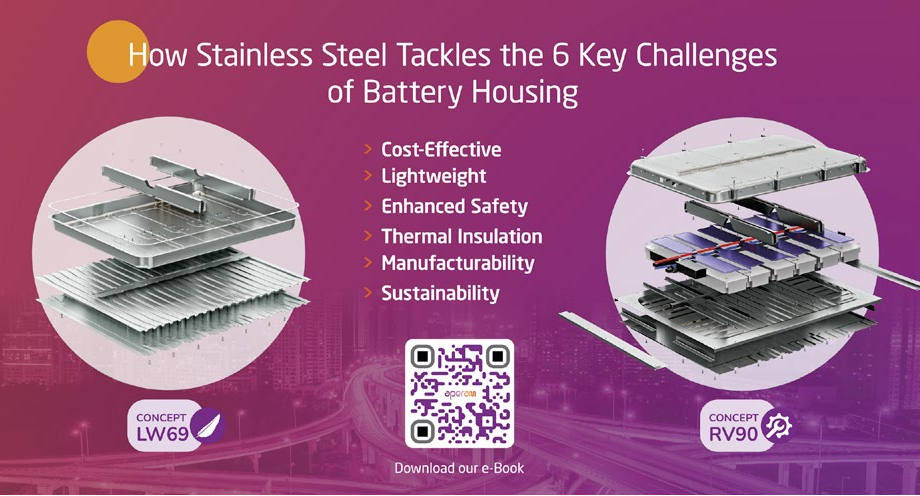
Prototypes, developed in cooperation with Ricardo, have demonstrated that stainless steel battery housings can function as integral structural parts. They passed side pole and underbody puncture tests. Aperam offers stainless strips and sheets in widths of up to two metres. Combined with their high formability, this enables the production of large, complex components through a simplified manufacturing process. All standard automotive joining techniques are compatible with stainless steel, including bolted connections, which enhance battery pack repairability. Protective measures are available for joints with dissimilar metals to prevent galvanic corrosion. Mixed-material designs incorporating polymers and composites are also feasible.
Compatibility and corrosion resistance
Inherently corrosion-resistant, stainless steel eliminates the need for additional protective coatings, simplifying logistics and reducing risk at cut edges and heavily formed areas.Long-term exposure tests under harsh conditions, such as samples mounted under lorries, have shown no corrosion after two years. Stainless steel is also compatible with the chemical environment of EV batteries, resisting attack from dielectric fluids. Aperam R&D supports OEMs in selecting appropriately specified grades.
Although the €/t cost of stainless steel is higher than that of other metallic materials, a systemwide approach demonstrates that it delivers the most advantageous total cost of ownership (TCOE) combined with superior technical performance. To further improve competitiveness, Aperam has developed 316A — a cost-optimised variant of 316L. By leveraging a synergy between silicon and other alloying elements in the passive layer, 316A reduces molybdenum content while maintaining the corrosion
resistance and processing characteristics of 316L.
Application potential for ferritic and duplex grades
Ferritic grades, free of nickel, offer a more economical alternative and exhibit higher thermal conductivity, making them suitable for battery cooling systems. They also demonstrate superior high-temperature resistance in thermal runaway scenarios. Duplex grades combine exceptional corrosion resistance with significantly higher strength than austenitic or ferritic alternatives. Aperam supplies duplex stainless steel in thicknesses down to 0.5 mm, suited for battery housing covers.
Low-carbon, European-made solutions
Aperam’s stainless steels for the EU market are produced in France and Belgium using electric arc furnaces and up to 98% recycled content (Aperam infinite™range). Their proximity to automotive customers enables short lead times and flexible deliveries. In addition, Aperam’s stainless steel service centres across Europe simplify the logistics, further ensuring responsiveness and supply reliability.
Through its recycling subsidiary ELG, Aperam collects production scrap from customers and returns it to its melt shops for reprocessing. From mechanical performance to fire safety, corrosion resistance and recyclability, stainless steel offers a technically and economically efficient solution for EV battery housings — supporting the automotive sector in addressing design, manufacturing and sustainability challenges.